Aubrey Rugroden

Night Watch: Pinata Panic
15-Member Team | Unreal Engine
Production Manager | Level Designer | Technical Designer
I led a multidiscipline team of 15 people to create the physics sandbox adventure game, Pinata Panic. Along with structuring team goals, communicating with executive stakeholders, and coordinating multiple subteams of different skillsets and disciplines, I also wireframed the levels and iterated them through user feedback. I also worked closely with the engineering team to create tools and systems for rapid iteration and gameplay exploration.
* * * * *
The Project
Cutting content, especially your own, is always a difficult thing to do. As the producer for Pinata Panic, it was my duty to know when to reduce scope for the sake of keeping everything deliverable and of a quality we're all happy with. As the level designer, I want as many levels as needed to give a holistic experience and show players everything we have to offer.
Upon leaving pre-production, our art team leaned into prioritizing asset production. It quickly became clear that their bandwidth was shorter than anticipated (due to many factors, including a team composition shuffle). As such, the ability to do art passes on pre-production content was greatly reduced. We had already proposed three levels to executive stakeholders, and I had already made wireframes for all three. However, I worked with the art lead to determine where we could most effectively reduce scope, and levels became the clear target. With the help of our systems designer, I combined Level 1 (with a more linear, "tutorial-style" layout) with level 3 (with a more nonlinear, "central-landmark" style layout) and scrapped level 2 altogether.
This decision to cut level content proved very successful in providing artists with the bandwidth they needed to produce asset final passes, and paid dividends in the efficiency of content finalization. It's always difficult to cut content, but we did so effectively by consulting team leadership and putting my owned content on the chopping block.

Knowing When to Cut
Pigeon Simulator was a strong learning experience for everyone involved on the project. With an ever-changing set of deliverables, project visions and milestone goals, I did my best to utilize my project management experience to help steady the ship during troubled waters.
I was a champion for user-directed decision-making. Who are we making this game for? What do they need out of their games? What have we already done to satisfy those needs, and what can we do to expand those things? I worked closely with the production manager, art and development leads, and other relevant stakeholders to maintain a consistent project vision and a strong plan that's within scope and within our personal development goals.
I also owned major chunks of the game's design during these pivots. I guided conversations about the design's direction and was consulted on how specific segments of the design fit into the holistic vision. My priority was velocity and adaptability during these pivots. Maintaining consistent design documentation, hosting large and small discussion sessions, and owning responsibility of prototype iteration kept the team in high morale and in strong vision during these turbulent periods of development.

Supporting Large Pivots
The player in Pigeon Simulator has a ton of abilities available to them. Apart from flying around, pooping on stuff and eating food (and batteries, and guns, and-), pigeons in this world can also breathe fire, use telekinesis, become hulking Buff Pigeons, cause blizzards, destroy just about any prop or building, kill just about anyone, and detonate nuclear warheads. Needless to say, this posed some design challenges for gameplay spaces.
With such an open sandbox, the focus of my level design was to confront the biggest problem: How will players know where the fun is? If everything is a nail and the player is a flying ball of hammers, how do you make this interesting? I chose to embrace the chaos.
Levels in Pigeon Simulator used points of "gravity" to guide players around. Smaller, less "unique" areas had low gravity, and larger areas with unique structures had high gravity. From the player's perspective, high-gravity points of interest could be seen from just about anywhere, and heading to one means players will naturally find lower-gravity, smaller interactions that invite quick interaction along the way. Instead of forcing the player down set paths, the player is free to make their own path with the level naturally suggesting interactions of varied sizes, levels of interest and rewards.

Small Pigeon, Big Interactions
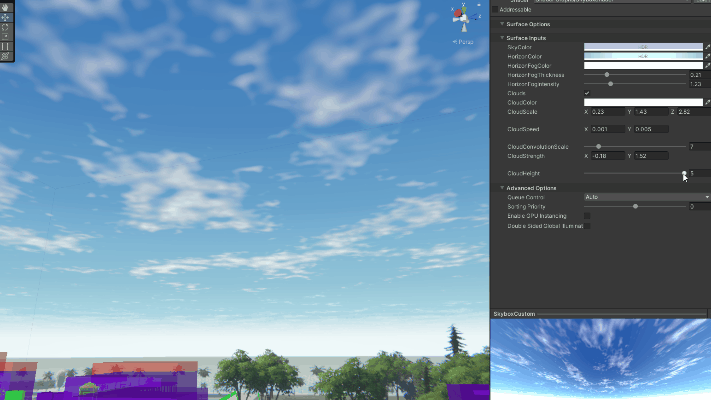
The HakJak Studios team was a small and incredibly passionate group of creatives. I was hired on to perform design tasks, but I made sure that my spare time was used to benefit my peers. I developed tools, such as the custom skybox shader I wrote (shown here), custom render pipeline improvements, UI style sheets (shown below) and other development assistance mechanisms to benefit the velocity of the project and effectiveness of the team.
I always try to make iteration and project exploration as easy and low-friction as possible, and helping my team accomplish their goals effectively is a valuable skill that I've come to appreciate building.
Supporting a Talented Team

A segment of UI style guide I made used to assist art direction on UI and HUD development in Pigeon Simulator.